
Welding and temperature
Confirm filler-metal selection and relevant time-temperature exposure; stabilization alone does not establish design suitability.
Stainless Steel Round Bar
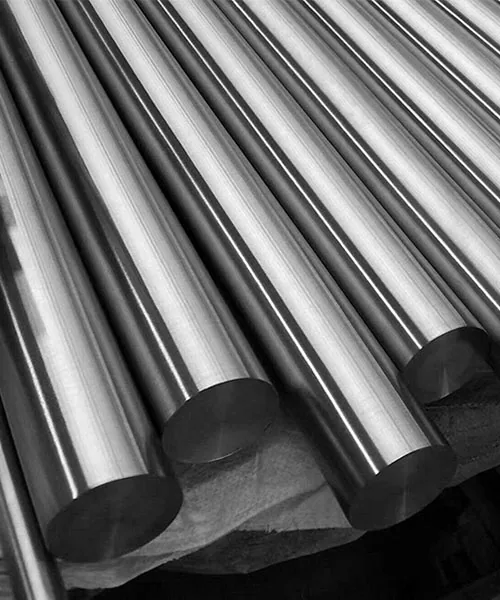
Stainless Steel 347 Round Bar (UNS S34700) is a niobium-stabilized austenitic stainless steel bar used for machined and fabricated components, including equipment exposed to welding or elevated temperatures.
Piyush Steel India supplies material enquiries for SS 347 round bars to the required size, supply condition, product specification and inspection documentation. The grade is also commonly referenced as EN 1.4550 and JIS SUS 347, subject to the applicable standard.
Send the diameter, length, quantity, standard, finish and required tests to receive a specification-based quotation.
At a glance
Grade equivalents and technical limits must be checked against the governing product standard and actual material certificate.
Material selection
SS 347 is a chromium-nickel austenitic stainless steel stabilized with niobium (also called columbium). The stabilizing addition preferentially combines with carbon and reduces the formation of chromium carbides at grain boundaries under relevant thermal conditions. This makes the grade useful in some welded or elevated-temperature components where sensitization is a concern.
The stabilization does not make 347 suitable for every corrosive or high-temperature environment. Check service temperature, exposure time, atmosphere, design stress and any governing pressure-equipment code. In chloride-containing environments, compare the service conditions with molybdenum-bearing grades such as SS 316.
Industrial uses
Round bar is used where components are machined from solid sections. Typical applications considered for SS 347 include:
Applications are illustrative, not a guarantee of suitability for a given pressure, temperature or corrosive medium.
Specifications
Specify the final diameter, tolerance, straightness, length, surface condition and certification. The following are the size and finish references published on the original page; they are not verified current-stock commitments.
| Product detail | Source-page reference / ordering guidance |
|---|---|
| Round-bar diameter | 6–300 mm across the original listed ranges; confirm the required diameter |
| Lengths | 1–6 m in the original examples; cut lengths by agreement |
| Surface finishes | Bright, black, polished, ground, pickled or cold-drawn as applicable |
| Bar product specifications | ASTM A276; ASTM A479 for the applicable bar end use |
| Other referenced specifications | EN 10088-3; JIS G4303, subject to grade and edition confirmation |
| Other bar forms | Square, hexagonal or forged forms may be quoted separately; confirm availability |
Do not assume that a single dimensional tolerance applies to every diameter or production process. State the applicable dimensional standard and any machining allowance on the purchase order.
Chemical composition
Reference values below are based on the uploaded source page and are presented for initial grade identification, not as a certified heat analysis. The stabilizing-element requirement requires particular care because standards may express the niobium-plus-tantalum requirement differently.
| Element | Composition, wt. % (source reference) |
|---|---|
| Carbon (C) | 0.08 max |
| Manganese (Mn) | 2.00 max |
| Silicon (Si) | 1.00 max |
| Phosphorus (P) | 0.045 max |
| Sulfur (S) | 0.030 max |
| Chromium (Cr) | 17.0–19.0 |
| Nickel (Ni) | 9.0–12.0 |
| Niobium + tantalum (Cb + Ta) | Stabilizing addition: verify specified limits; the source page gives Cb as 10 × C min to 1.10 max |
| Nitrogen (N) | 0.10 max (source-page reference) |
| Iron (Fe) | Balance |
Verify the niobium/tantalum, nitrogen and all other limits against the exact ASTM, EN or JIS product specification and edition before using the table for procurement or acceptance.
Mechanical properties
These values reproduce or qualify the original page's mechanical-property references. Actual acceptance limits depend on the specified bar standard, dimensions, test condition and heat treatment.
| Property | Source-page value / qualification |
|---|---|
| Ultimate tensile strength | 515 MPa minimum |
| 0.2% proof/yield strength | 205 MPa minimum |
| Elongation in 50 mm | 30% minimum |
| Reduction of area | 40% minimum |
| Hardness | 85 HRB (source-page reference; verify condition and acceptance limit) |
| Modulus of elasticity | 200 GPa (approximate) |
| Poisson's ratio | 0.30 (approximate) |
Hardness is not stated here as NACE MR0175 compliance. Compliance with any sour-service standard requires a separate material and application assessment.
Before ordering
Confirm filler-metal selection and relevant time-temperature exposure; stabilization alone does not establish design suitability.
State the full specification and edition. ASTM A276 and ASTM A479 have different procurement contexts.
Agree bar form, condition, machining allowance, straightness and surface tolerances.
Request heat number, material test certificate and any additional testing needed for the project.
Designations
| System | Designation / reference |
|---|---|
| UNS | S34700 |
| AISI / SAE | 347 |
| EN material number | 1.4550 |
| EN grade name | X6CrNiNb18-10 |
| JIS | SUS 347 |
These names help cross-reference material requests but do not automatically guarantee identical chemical, mechanical or delivery requirements across standards.
Compare with SS 321 Round Bar (titanium-stabilized), SS 347H Round Bar (higher-carbon variant for certain high-temperature applications), and SS 304 Round Bar (general-purpose austenitic stainless steel). Grade changes require engineering approval.
Product questions
It is a round bar made from niobium-stabilized austenitic stainless steel 347 (UNS S34700), selected for fabricated components that may experience welding or elevated-temperature exposure.
Both are stabilized austenitic grades. SS 347 uses niobium (columbium), while SS 321 uses titanium. Selection depends on the drawing, fabrication process and operating conditions.
SS 347H (UNS S34709) is the higher-carbon variant intended for certain elevated-temperature service conditions. They are not automatically interchangeable; use the grade and code requirements specified.
Grade 347 is commonly used for welded fabrication because niobium stabilization helps reduce chromium-carbide sensitization. Welding procedure, filler selection and any required heat treatment still need review.
ASTM A276 and ASTM A479 are possible bar specifications, depending on the purchase application. EN 10088-3 and JIS G4303 may be referenced where applicable. Confirm the required edition, condition and acceptance criteria.
Provide grade or UNS number, governing standard, diameter, length, quantity, supply condition, surface finish, tolerances, tests, inspection documents and delivery location.
Specification-led enquiries
Include the governing standard, dimensions, quantity, condition, testing requirements, documentation, and destination.