
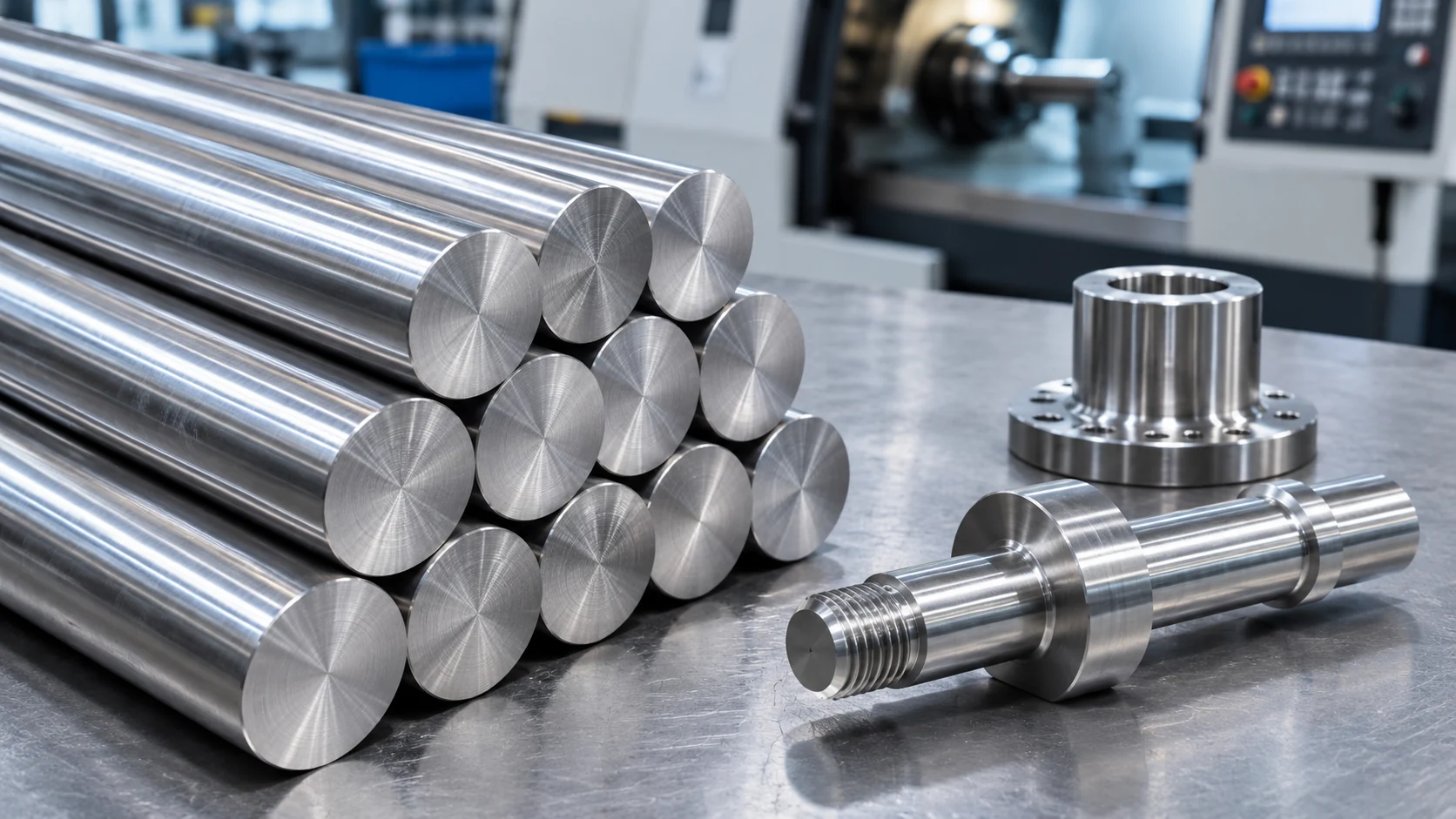
What is stainless steel 303 round bar?
Grade 303 is an austenitic stainless steel, identified as UNS S30300 and commonly cross-referenced as EN 1.4305. It is closely related to 304 stainless steel, but it contains added sulfur to make cutting, drilling and turning easier.
That small change makes a difference in a machine shop. If a workshop is making hundreds of threaded pins or small fittings, easier chip breaking and more predictable machining can save time. You can see the material itself on our SS 303 round bar product page.
Why do machinists choose grade 303?
Machining stainless steel can be slow when chips become long and difficult to control. Grade 303 is designed to reduce that problem. Sulfur helps create small inclusions in the steel that encourage chips to break as the tool cuts.
This is particularly useful for CNC turning, drilling, tapping and repetitive production work. The actual result still depends on bar condition, tool geometry, cutting fluid, machine setup and the part design. Grade 303 is not automatically the best material for every machine or every component.
Key properties and standards to know
When reading a drawing or ordering material, use the complete grade and product specification rather than the phrase “303 stainless” alone.
| Item | Grade 303 |
|---|---|
| Material family | Austenitic stainless steel |
| Common designation | AISI 303 / UNS S30300 |
| European designation | EN 1.4305 (check governing standard) |
| Typical bar specification | ASTM A582/A582M for free-machining stainless steel bars |
| Main advantage | Good machinability and chip control |
| Main limitations | Less corrosion resistance and poorer weldability than 304 |
| Heat treatment | Not hardenable by conventional heat treatment |
Other bar standards or customer specifications may be relevant depending on the order. Always check the required condition, diameter tolerance, test certificate and specification edition. Our quality assurance information explains the documentation details buyers should agree before supply.
Where is 303 round bar commonly used?
303 is a practical choice when a component needs several machining steps but will not spend its life in a highly corrosive environment. Typical examples include:
- Turned pins, studs and threaded fasteners
- Small shafts, spacers and bushings
- Precision fittings, couplings and machined inserts
- Machine components and instrument parts
- Parts produced in repeated batches on automatic lathes
The grade should still be checked against the working environment, load and drawings. A part that is easy to manufacture is not necessarily suitable for marine or chemical service.
Stainless steel 303 vs 304: which should you choose?
303 and 304 are both common stainless grades, but they solve different problems. The better choice depends on how the part will be made and where it will be used.
| Factor | 303 | 304 |
|---|---|---|
| Machining | Easier for repetitive cutting and turning | Generally more difficult to machine |
| Corrosion resistance | Lower due to sulfur additions | Generally better |
| Welding | Generally not recommended where welding is important | Usually the better choice |
| Typical priority | Machining efficiency | General corrosion resistance and fabrication |
Choose 303 when machining is the main challenge and the exposure is relatively mild. Choose 304 stainless steel round bar when welding, fabrication or better general corrosion resistance matters more.
Stainless steel 303 vs 316: what is the difference?
Grade 303 is usually selected when machining speed and chip control are the main concerns. Grade 316 contains molybdenum and generally offers better resistance to pitting in chloride-containing environments than 303, making it a more suitable starting point for some wet or chemically demanding applications. That does not mean 316 is suitable for every corrosive service: temperature, concentration and operating conditions still matter. For specifications and supply enquiries, see our stainless steel 316 round bar page.
When should you avoid 303?
Do not select 303 simply because it machines faster. The sulfur that improves chip formation also makes the grade less suitable for demanding corrosion service and can cause problems during welding. For parts exposed to chlorides, chemicals or frequent wet conditions, the material choice needs a closer review.
For more demanding corrosion environments, engineers may consider 316 stainless steel round bar, subject to the actual service conditions. A change from 303 to 304 or 316 is a design decision, not an automatic substitution.
What should you check before ordering 303 round bar?
A short, complete enquiry helps avoid the wrong bar being supplied. Include the grade, the required standard, diameter, length, quantity and delivery condition. If the bar will be used for close-tolerance machining, mention the finish and tolerance as well.
Ask for the required mill test certificate and heat identification, and confirm any inspection or marking needs before dispatch. You can browse the broader stainless steel round bar range or send the drawing and requirement through our enquiry form.
Common questions about SS 303 round bar
Is 303 stainless steel good for CNC machining?
Yes. Grade 303 is designed for better machinability and is often chosen for turned and threaded components made in repeated batches.
Is stainless steel 303 the same as 304?
No. They are related austenitic grades, but 303 contains added sulfur to improve machining. That also reduces its corrosion resistance and weldability compared with 304.
Can SS 303 round bar be welded?
Welding is generally not recommended because the sulfur content increases the risk of cracking. Choose a more suitable grade if welding is part of the design.
Is ASTM A582 used for 303 round bars?
Yes. ASTM A582/A582M is a common specification for free-machining stainless steel bars, including 303. Check the exact edition and order conditions.
Does 303 stainless steel rust?
It is corrosion resistant, but it is not rust-proof. Harsh chemicals, chlorides, contaminated surfaces and unsuitable environments can still cause corrosion.