
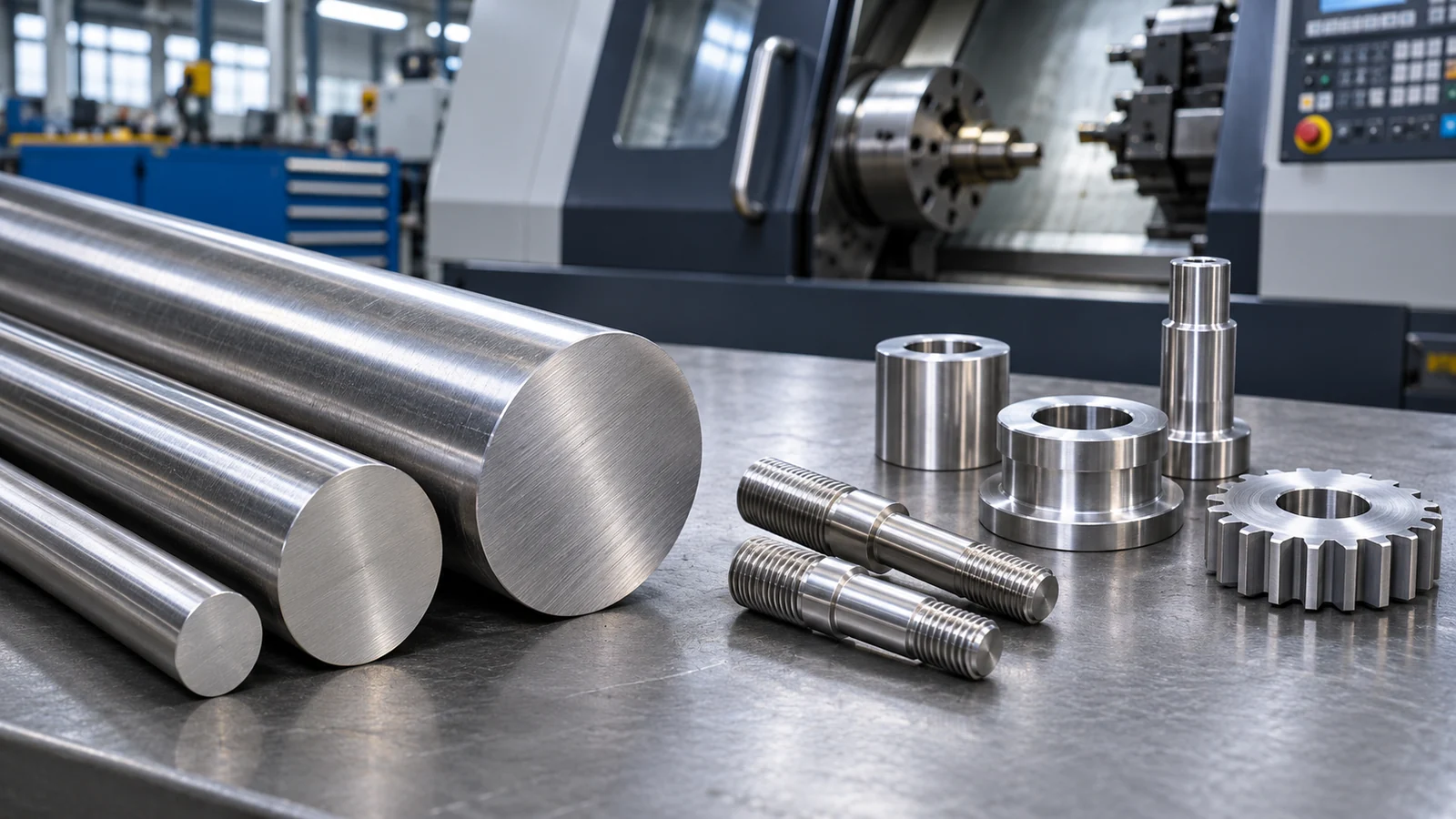
What is 430F stainless steel round bar?
Some stainless steel grades are selected because they can handle aggressive chemicals. Others are chosen because a machine shop can turn them into accurate components without constant problems with chips. 430F stainless steel round bar falls into the second group.
430F (UNS S43020) is a free-machining ferritic stainless steel with approximately 16–18% chromium. It is derived from grade 430, with sulfur deliberately added to make cutting easier. It remains magnetic and cannot be hardened by conventional heat treatment. The 430F round bar grade page covers the material in supply form; here we focus on how engineers decide whether it belongs in a component.
Its key trade-off is straightforward: easier machining in exchange for some corrosion resistance and weldability.
Is 430F stainless steel magnetic?
Yes. 430F is normally magnetic because it has a ferritic stainless steel structure. This distinguishes it from typical annealed austenitic grades such as 303 and 304, which are generally much less magnetic.
But magnetic attraction alone is not enough for a solenoid or electromagnetic device. A component may need a specified permeability, coercivity or magnetic response. Those properties depend on chemistry, processing and heat treatment, not just the grade name.
Ordinary 430F is not automatically solenoid-quality 430F
Special 430F solenoid-quality material is produced with controlled chemistry and processing to achieve more consistent magnetic properties. If the component is a solenoid core, magnetic plunger or valve part, request the magnetic-property requirements on the drawing rather than assuming ASTM A582 bar will meet them.
How does 430F behave during machining?
A long, stringy chip can wrap around a rotating part, interfere with coolant and slow production. 430F addresses this problem through sulfur-bearing inclusions that help chips break during cutting.
This can benefit CNC turning, automatic screw machining, drilling and threading. It may support shorter cycle times and steadier production when tooling, cutting speed, feed and coolant are properly chosen. These outcomes are not guaranteed simply by using the grade.
What a machinist should check
- Bar condition: hot-finished, cold-finished and other delivery conditions can cut differently.
- Tool selection: match insert grade and geometry to the operation and actual hardness.
- Chip evacuation: inspect drilling and internal turning operations where chips have limited space.
- Surface quality: evaluate the finish and burr formation on the actual production part.
When surface finish and accurate starting dimensions are critical, confirm whether a suitable bright round bar finish is required before machining.
What does the chemistry of UNS S43020 tell us?
Chromium provides the stainless steel's basic corrosion resistance. Sulfur is added primarily to improve machinability. The following values are reference chemistry limits from a published 430F technical datasheet, not a substitute for the controlling purchase specification.
| Element | 430F reference composition (mass %) |
|---|---|
| Chromium | 16.00–18.00 |
| Carbon | 0.12 max |
| Manganese | 1.25 max |
| Silicon | 1.00 max |
| Phosphorus | 0.060 max |
| Sulfur | 0.150 min |
| Molybdenum | 0.60 max in referenced datasheet |
| Iron | Balance |
The sulfur is a useful machining addition, but sulfide inclusions can also become preferred sites for localized corrosion. That is why a free-machining grade should not be chosen solely on its chromium percentage.
Where is 430F stainless steel used?
430F is used for machined components in suitable, relatively mild service environments. Typical examples include:
- Threaded pins and small fastener-like parts made on automatic lathes.
- Gears and turned mechanical parts where the material's strength and wear properties are adequate.
- Sleeves, spacers and fittings requiring several turning or drilling operations.
- Selected aircraft and industrial components, subject to the applicable engineering specification.
- Magnetic valve components only when the required magnetic characteristics are specified and verified.
End use is never enough to approve a grade. Load, fatigue, operating fluid, temperature, corrosion exposure and any mandatory code all affect the choice.
430F vs 430 vs 416: what changes?
These three stainless steels may appear in the same machining discussion, but they are intended for different priorities.
| Selection factor | 430F | 430 | 416 |
|---|---|---|---|
| Stainless steel family | Ferritic | Ferritic | Martensitic |
| Primary advantage | Free machining | General ferritic corrosion performance and formability | Free machining with heat-hardening capability |
| Magnetic behaviour | Generally magnetic | Generally magnetic | Generally magnetic |
| Can conventional heat treatment harden it? | No | No | Yes |
| Welding | Generally poor | Generally more suitable than 430F, with precautions | Challenging; procedure-dependent |
| General selection | Extensive turning and threading | Fabrication and less demanding machining | Machined parts needing heat-treated hardness |
For ordinary ferritic parts where machining is not the main obstacle, compare grade 430 round bar. When the drawing calls for heat-treated hardness, review grade 416 round bar. Each change requires engineering approval rather than a direct grade substitution.
What about 303 stainless steel?
303 stainless steel is also free machining, but it is austenitic and behaves differently in magnetic and corrosion-related applications. If magnetism is a genuine design requirement, 303 is not an automatic replacement for 430F.
Where should 430F not be used?
430F is useful precisely because it makes a trade-off. It is a poor default choice when that trade-off becomes a safety or service-life concern.
- Welded assemblies: sulfur increases weld-cracking susceptibility, so select a more suitable grade where welding is essential.
- Aggressive corrosion environments: chloride exposure, persistent wetting and certain chemicals may demand more resistant alloys.
- Pressure-containing equipment: a published manufacturer datasheet explicitly advises against 430F for vessels holding gases or liquids under high pressure.
- Parts requiring through-hardening: conventional quench-and-temper treatment does not harden 430F.
- Unverified electromagnetic applications: a general bar certificate does not establish the magnetic properties needed in a solenoid design.
If corrosion is more important than magnetic ferritic behaviour, engineers may consider a grade such as 316 stainless steel round bar, depending on the real service conditions.
How should you specify 430F round bar?
A correct order identifies both the alloy and the delivery requirements. A commonly used free-machining bar specification is ASTM A582/A582M. Confirm the exact edition and whether the application needs supplementary requirements.
Include the UNS S43020 grade, bar diameter, length, quantity, delivery condition, finish, dimensional tolerances, test report and heat traceability. If a drawing needs controlled magnetic characteristics, add the acceptance limits and test method explicitly.
Our quality assurance page provides context on inspection and documentation. Grade, condition and inspection requirements should always be agreed before supply.
Frequently asked questions about 430F
Is 430F stainless steel magnetic?
Yes. Its ferritic structure makes it generally magnetic, but specific solenoid performance must be separately verified.
What is the UNS number for 430F stainless steel?
UNS S43020 identifies Type 430F, a chromium-containing free-machining ferritic stainless steel.
Why is sulfur added to 430F?
Sulfur improves chip breaking during machining, although it can also reduce corrosion resistance and weldability.
Can 430F stainless steel be welded?
It is generally a poor welding choice because sulfur increases cracking risk. Review another grade for welded assemblies.
Is 430F the same as 430F solenoid quality?
No. Solenoid-quality material is specially processed for controlled magnetic behaviour; standard 430F does not guarantee those properties.
Does ASTM A582 cover 430F round bars?
Yes. ASTM A582/A582M is a common specification for free-machining stainless steel bars, including 430F.