
Standard and edition
Confirm the controlling document; a grade name or cross-reference alone is not a complete acceptance specification.
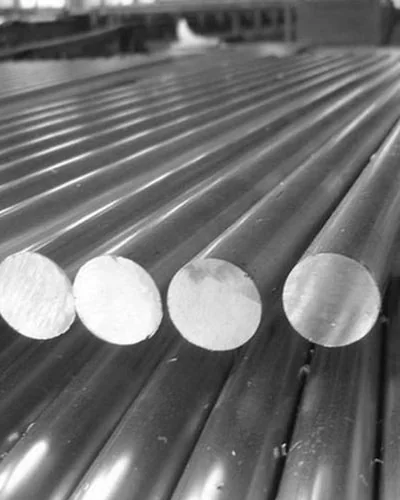
Titanium Round Bar
Titanium Grade 2 is commercially pure titanium (UNS R50400) with good corrosion resistance, low weight and a useful balance of strength and formability. It is stronger than Grade 1 and is used for parts exposed to seawater and selected chemicals.
Grade 2 round bars are used to make shafts, pump parts, fittings and other machined components. Confirm ASTM B348, the required diameter, annealed condition, tolerances and inspection documents when ordering.
At a glance
Confirm the applicable specification and availability for your required size and condition.
Buyer selection guide
Begin with the drawing, equipment specification, or governing code. The product name identifies the material route; acceptance depends on the complete purchase specification.
Common applications
Titanium Grade 2 is used when corrosion resistance, moderate strength and low weight are important. Typical components made from Grade 2 round stock include:
Where greater formability is needed, consider Titanium Grade 1 round bar. The grade must still be selected for the actual operating conditions.
Specifications
| Requirement | Information |
|---|---|
| Material | Commercially pure titanium, Grade 2 |
| UNS designation | R50400 |
| Material number | 3.7035 |
| Bar standard | ASTM B348/B348M Grade 2; ASME SB-348 when specified |
| Product form | Solid titanium round bar and rod |
| Supply condition | Annealed, as applicable to ASTM B348 |
| Surface finish | Descaled, ground, rough turned or other agreed finish |
| Diameter and length | Confirm the required size, length and availability before ordering |
| Dimensional tolerances | Specify diameter tolerance, straightness, length and machining allowance |
| Inspection documentation | Material test certificate and inspection reports as required by purchase order |
Sizes, finishes and lengths require confirmation. ASTM B348 has size-dependent provisions for tensile properties; specify the actual bar diameter and standard edition.
Chemical composition
| Element | Grade 2 limit (wt. %) |
|---|---|
| Carbon (C) | 0.08 max |
| Nitrogen (N) | 0.03 max |
| Oxygen (O) | 0.25 max |
| Hydrogen (H) | 0.015 max |
| Iron (Fe) | 0.30 max |
| Other elements | 0.10 each max; 0.40 total max |
| Titanium (Ti) | Balance |
ASTM B348 Grade 2 (UNS R50400) composition limits. Check the material test certificate and the edition specified on the purchase order.
Mechanical properties
| Property | Annealed ASTM B348 Grade 2 reference |
|---|---|
| Tensile strength, minimum | 345 MPa (50 ksi) |
| 0.2% yield strength, minimum | 275 MPa (40 ksi) |
| Elongation, minimum | 20% |
| Reduction of area, minimum | 30% |
| Density, typical | 4.51 g/cm³ |
These are reference minimums for annealed Grade 2 bar, subject to the applicable bar-size and standard-edition provisions. Confirm actual test results on the MTC. Density is a typical value.
Technical considerations
Confirm the controlling document; a grade name or cross-reference alone is not a complete acceptance specification.
Check that property values apply to the required diameter, heat treatment, test direction and temperature.
State tolerances, straightness, length, surface finish, machining allowance, and end condition where required.
Define inspection, test reports, marking, heat identification, third-party requirements, and destination documentation.
Material designations
| Reference | Designation |
|---|---|
| Titanium designation | Commercially pure titanium Grade 2 |
| UNS | R50400 |
| Werkstoff number | 3.7035 |
| ASTM bar specification | ASTM B348/B348M |
| ASME bar specification | ASME SB-348 when specified |
These are material identifiers and related bar specifications, not proof that all products made under different standards are automatically interchangeable.
Product details
Titanium Grade 2 bar may be supplied with a descaled, ground or turned finish, depending on the specification and order. For close-tolerance parts, agree on the starting diameter, straightness and extra stock needed for machining. A finished dimension should not be assumed from the nominal bar size.
Grade 2 can be machined and welded, but titanium needs suitable cutting conditions and careful control of heat. Welding requires clean material and proper inert-gas shielding, including protection while the weld cools. Prevent contact with steel grinding dust and other contamination during fabrication. Compare Titanium Grade 3 where the design needs higher strength.
Specify whether the order requires chemical analysis, tensile testing, dimensional inspection and an EN 10204 3.1 certificate. Marking and heat identification should allow the supplied bars to be matched to the test report. Use the titanium round bar category to review other grades before finalising the purchase specification.
Product questions
Grade 2 bars are machined into pump parts, shafts, fasteners, fittings and equipment components used in suitable marine, water-treatment and chemical-processing environments.
ASTM B348/B348M covers annealed titanium bars and billets, including Grade 2 (UNS R50400). Confirm the required edition and any additional purchase requirements.
Grade 2 generally offers higher strength, while Titanium Grade 1 is softer and easier to form. Choose based on the finished component and its service conditions.
Grade 2 generally resists corrosion well in seawater, but temperature, crevices, contamination and operating conditions must be checked for the actual equipment.
Yes. Titanium Grade 2 is weldable when the material is clean and suitable inert-gas shielding protects the weld and hot surrounding metal from contamination.
Turned or ground finishes may be available. Specify the required diameter, surface condition, dimensional tolerance and length so availability can be confirmed.
Include ASTM B348 Grade 2 or UNS R50400, diameter, length, quantity, tolerances, annealed condition, certificate requirements and delivery destination.
Specification-led enquiries
Include the governing standard, dimensions, quantity, condition, testing requirements, documentation, and destination.